In his 2026 technology predictions, Amazon Chief Technology Officer Dr. Werner Vogels pointed toward an inevitable shift: personal AI companions and personalized learning systems are transitioning from experimental toys into ubiquitous daily fixtures. Within a few years, almost every engineer and knowledge worker will have an AI companion walking alongside them, operating as a constant digital presence in their terminal, browser, and decision-making loop.
This shift presents a profound fork in the road for human intellect:
- The Passive Trap: The majority of users will treat AI as an intellectual crutch. They will use it to skip reading documentation, bypass cognitive friction, and accept instant answers without mental verification. They will feel hyper-productive while their internal mental schemas steadily decay into cognitive atrophy.
- The Meta-Human Advantage: A smaller cadre of thinkers will recognize that human leverage does not come from outsourcing thought, but from meta-learning: the disciplined practice of monitoring and elevating your own thinking through an external cognitive partner.
The Core Takeaway: If you treat your personal AI as an automated oracle that hands you answers, you automate your own comprehension out of the system. To thrive in the companion era, you must become a Meta-Human: someone who applies meta-cognition (thinking about how we think) to turn an AI companion into a dynamic learning scaffold. You elevate the AI by providing structural invariants and mental models; the AI elevates you by surfacing your blind spots and accelerating your cognitive feedback loop.
The Academic Foundations: What Cognitive Science Teaches Us
To understand how to build an effective personal AI learning system, we must move past tech industry hype and examine the foundational papers of cognitive psychology and philosophy of mind.
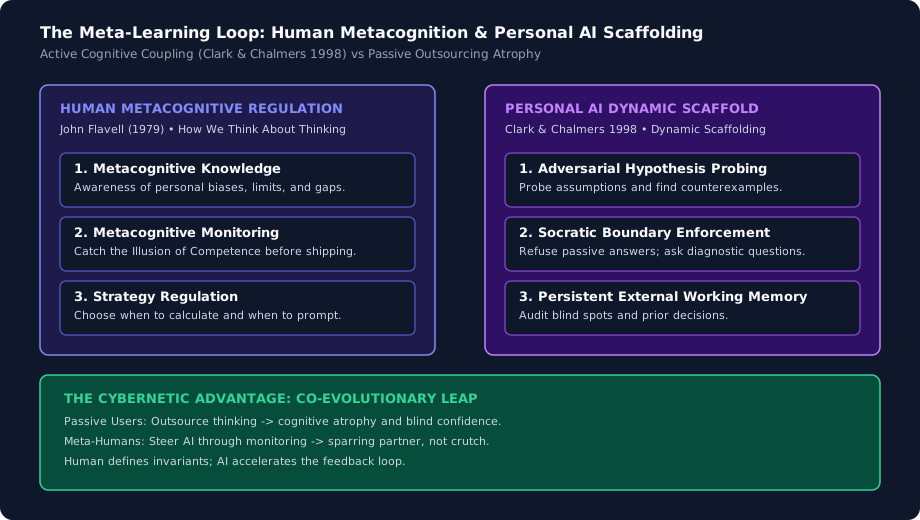
Figure 1: The Meta-Learning Loop. How human metacognitive monitoring (Flavell 1979) and personal AI scaffolding (Clark & Chalmers 1998 Extended Mind) create an active co-evolutionary learning engine.
1. Flavell (1979): Metacognition and Cognitive Monitoring
In his landmark paper “Metacognition and cognitive monitoring: A new area of cognitive-developmental inquiry” (American Psychologist, 1979), developmental psychologist John H. Flavell coined the term metacognition. He divided human thinking into four interacting components:
- Metacognitive Knowledge: What you know about your own mind: your cognitive strengths, personal biases, and knowledge limits.
- Metacognitive Experiences: The conscious, internal feeling of cognitive friction: that sharp feeling of confusion when a code block does not make sense, or the sudden realization that an assumption is flawed.
- Goals (Tasks): The actual intellectual objective you want to achieve.
- Strategies (Actions): The conscious techniques you deploy to monitor progress and verify that your mental model matches physical reality.
When an engineer blindly prompts an LLM with “Write a script to do X,” they completely bypass Flavell’s metacognitive monitoring. They skip the conscious feeling of cognitive friction and trade active comprehension for passive acceptance.
2. Clark & Chalmers (1998): The Extended Mind Hypothesis
In their 1998 paper “The Extended Mind” (Analysis), philosophers Andy Clark and David Chalmers challenged the boundary that cognition stops at the biological skull:
“If, as we confront some task, a part of the world functions as a process which, were it done in the head, we would have no hesitation in recognizing as part of the cognitive process, then that part of the world is part of the cognitive process.”
Clark and Chalmers showed that when an external tool is continuously, bidirectionally coupled to human thought: like Otto using his notebook to store memories: it becomes an integral component of the thinker’s cognitive architecture.
A personal AI companion is the ultimate manifestation of the Extended Mind. But the operative word is bidirectional coupling. If the AI merely does the work while you remain a passive consumer, there is no extended mind: there is only external delegation and human deskilling.
3. Vygotsky and Bruner: The Zone of Proximal Development & Scaffolding
Soviet psychologist Lev Vygotsky introduced the Zone of Proximal Development (ZPD): the cognitive zone between what a learner can do independently and what they can achieve with guidance. Jerome Bruner, David Wood, and Gail Ross formalized this in 1976 as Scaffolding.
In effective pedagogy, a scaffold is not an elevator that carries you up without effort. A scaffold is a temporary structure that supports the learner while they build their own internal load-bearing walls. As the learner masters the skill, the scaffold is gradually removed.
A personal AI should act as Bruner’s scaffold: it should challenge your reasoning, hold the cognitive boundary, and force you to operate at the edge of your ZPD without doing the core thinking for you.
4. Robert & Elizabeth Bjork: Desirable Difficulties vs The Illusion of Competence
Cognitive researchers Robert and Elizabeth Bjork demonstrated that learning feels easiest when it is least effective.
When you ask an AI for code and immediately read the solution, your brain experiences fluent recognition. You think, “Of course, that makes complete sense.” But recognition is an illusion. Unless your brain experiences desirable difficulty (the friction of active recall, hypothesis generation, and error correction), your long-term storage strength remains zero.
The Co-Evolution Loop: How Meta-Humans Build Personal AI Learning Systems
A Meta-Human does not interact with an AI as a customer issuing tickets to a junior contractor. A Meta-Human interacts with an AI as an intellectual sparring partner in a cybernetic loop:
┌────────────────────────────────────────────────────────┐
│                   HUMAN METACOGNITION                  │
│  Metacognitive Knowledge • Hypothesis Formation        │
│  Boundary Definition • Awareness of Cognitive Biases   │
└───────────────────────────┬────────────────────────────┘
                            │ Structured Constraints & Models
                            ▼
┌────────────────────────────────────────────────────────┐
│                PERSONAL AI COGNITIVE SCAFFOLD          │
│  Adversarial Counterexamples • Socratic Inquiries      │
│  Extended Working Memory • Edge-Case Synthesis        │
└───────────────────────────┬────────────────────────────┘
                            │ Cognitive Feedback & Probing
                            ▼
┌────────────────────────────────────────────────────────┐
│                   HUMAN METACOGNITION                  │
│  Schema Reconstruction • Mental Model Elevation        │
│  Physical Verification • Long-Term Knowledge Synthesis │
└────────────────────────────────────────────────────────┘
Here are three concrete engineering protocols to build this learning engine into your daily workflow:
Protocol 1: The Socratic Inversion (Never Ask for Answers)
When confronting an unfamiliar codebase or complex technical domain, the natural temptation is to ask: “How do I implement this?”
A Meta-Human inverts the query completely:
BAD PROMPT (Passive Outsourcing):
"Write me an algorithm to handle out-of-order event streams in Go."

META-HUMAN PROMPT (Active Scaffolding):
"I am designing an out-of-order event processor in Go. Here is my current mental model:
 1. I plan to use a priority queue bounded by a sliding watermarked window.
 2. If an event timestamp is older than (current_watermark - 5s), it drops to a dead-letter queue.
 3. I assume network latency jitter has a standard deviation under 500ms.

Do not write the implementation code.
Act as an adversarial distributed systems architect:
Identify the three weakest assumptions in my mental model, and present a concrete failure scenario that would break my state machine."
By forcing the AI to attack your mental model rather than generate code, you force your brain through active hypothesis testing. You retain full ownership of the problem space.
Protocol 2: Structured Decision Models Over Ambiguous Prompts
In complex software engineering, free-form natural language is sloppy. It encourages hallucination and hand-waving.
As we explored in our deep dive into TypeSafe’s Jev and decision models, replacing loose conversational prompts with typed, structured decision schemas eliminates ambiguity.
When training your personal AI companion on your architectural thinking:
- Define your decision invariants explicitly.
- Require the AI to categorize trade-offs into structured dimensions: latency budget, memory allocation ceiling, blast radius, and recovery mechanics.
- Review the outputs using the layered boundaries established in The Four-Layer AI Coding Stack.
Protocol 3: Externalizing Metacognitive Monitoring
One of the hardest challenges in software engineering is catching your own blind spots. We all have recurring biases: some engineers consistently under-estimate database lock contention; others over-complicate caching architectures.
Use your personal AI companion as an externalized metacognitive mirror:
"Review this architectural pull request.
Do not tell me if the code looks clean.
Compare my design against my recorded historical design blind spots:
 1. Did I introduce an unbounded memory allocation under downstream failure?
 2. Did I assume clock synchronization where vector clocks are required?
 3. Did I leak internal domain models across service boundaries?
Provide an evidence-backed audit for each point."
By delegating the audit to an external partner while retaining strict independent grading (as outlined in Why I Don’t Let AI Grade Its Own Work), you turn your companion into an active defense against cognitive drift.
Recommended Learning Paths & Cognitive Deep Dives
To continue developing your personal learning system and systems intuition, explore these related essays from our archive:
- Building Intuition from Scratch: Read How I Started Learning Reverse Engineering to see how tackling low-level binary crackmes forces active reconstruction and breaks the illusion of competence.
- Theoretical Computation Limits: Read Alan Turing’s 1936 Proof to understand why formal state machines and undecidability define what algorithms can and cannot compute.
- Structured Decision Frameworks: Read Inside TypeSafe’s Jev and Decision Models to see how to replace loose prompting with typed architectural evaluation.
- The Engineering Moat: Read Part 1: The Renaissance Developer for our breakdown of why systems synthesis across silicon and unit economics outlasts commoditized syntax.
What Comes Next
We have examined the systems engineer’s role in the AI era (Part 1) and how to build a personal AI learning scaffold through metacognition (Part 2).
In the final chapter of this series, we turn our gaze from human minds to the physical universe itself:
- Read Part 3: The Oldest Light: How We Measure 13.8 Billion Years Without a Stopwatch for an exploration of observational cosmology, how light from the early universe traveled 13.8 billion years to reach us, and an interactive simulation of cosmic expansion and redshift.