You often hear that the oldest light we can see was emitted 13.8 billion years ago. That statement is close, but subtly wrong.
13.8 billion years is the age of the universe itself. The oldest light we can observe: the Cosmic Microwave Background (CMB): was released approximately 380,000 years after the Big Bang. That light has been traveling through expanding space for roughly 13.787 billion years to reach our telescopes.
Nobody timed that light with a stopwatch. No human was there to record the timestamp. How do astrophysicists know the age of the cosmos with an uncertainty of less than 1%?
The answer comes from fitting a physical model of expanding space to precise satellite measurements of the early universe, then verifying that calculation against completely independent clocks.
The Core Takeaway: We can never see the Big Bang directly with light. Before 380,000 years, the universe was an opaque plasma fog where photons could not travel in straight lines. When the universe cooled to roughly 3,000 Kelvin, neutral hydrogen formed, and the fog cleared all at once. Over the next 13.8 billion years, cosmic expansion stretched that fiery orange glow by a factor of 1,100, cooling it into the cold 2.725 Kelvin microwave radiation we detect today.
The Simple Version: Four Pictures That Anchor the Physics
Cosmological calculations involve complex general relativity: the Friedmann-Lemaître-Robertson-Walker (FLRW) metric and tensor field equations. But the fundamental physics rests on four tangible mental models:
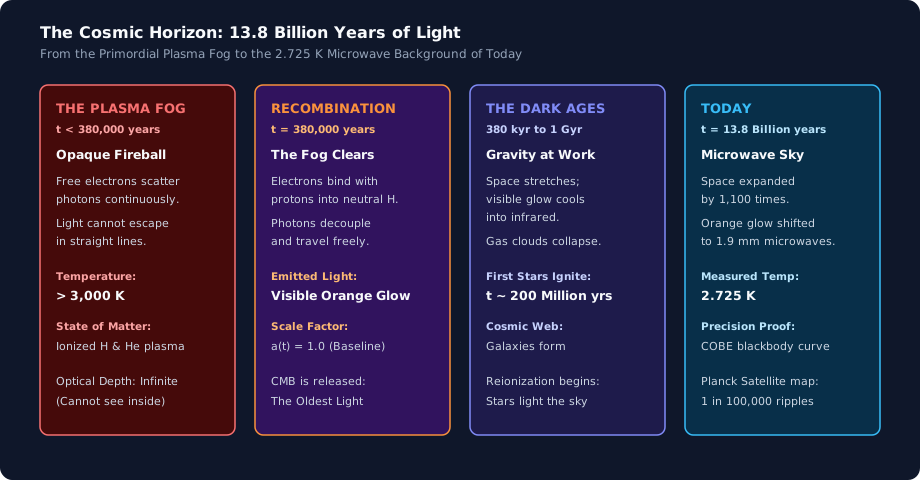
Figure 1: The Cosmic Timeline. From the opaque plasma fog to atomic recombination at 380,000 years, through the cosmic dark ages, to modern microwave detection.
1. The Fog Lifting (Recombination & Decoupling)
Imagine standing in thick, blinding fog. You cannot see more than two meters ahead because light continuously bumps into microscopic water droplets and scatters in random directions.
The baby universe was identical, except the “droplets” were loose, high-energy electrons. Protons and electrons moved too fast to bind together. Every time a photon traveled a tiny fraction of a millimeter, it collided with an electron (Thomson scattering). The universe was an opaque glowing soup.
As space expanded, the plasma cooled. When the temperature dropped to approximately 3,000 Kelvin, electrons slowed down enough to be captured by protons, forming neutral hydrogen atoms. Because neutral atoms do not scatter light nearly as easily as free electrons, the cosmic fog cleared everywhere all at once.
The light released at that precise instant is the Cosmic Microwave Background. We can never see past that barrier with optical telescopes for the exact same reason you cannot see into the center of a dense fog bank.
2. The Stretched Rubber Band (Cosmological Redshift)
Take a rubber band, draw a wavy sine wave on it with a pen, and pull the ends apart. The physical distance between the crests stretches out.
Space does the exact same thing to light traveling through it. This is not the familiar Doppler shift of a moving ambulance; it is cosmological redshift. The space itself through which the light travels is physically expanding.
When the CMB was released, it was orange-hot visible radiation (\(T \approx 3000\text{ K}\)). Over 13.8 billion years, the cosmic scale factor \(a(t)\) expanded by a factor of approximately 1,100. That stretching elongated the photon wavelengths by 1,100 times, shifting visible light into the microwave spectrum with a temperature of:
$$T_{\text{today}} = \frac{T_{\text{recombination}}}{1 + z} = \frac{3000\text{ K}}{1100} \approx 2.725\text{ K}$$3. Ripples in a Pond (Acoustic Oscillations)
Throw a handful of pebbles into a shallow pond and freeze the water instantly. By analyzing the frozen circular ripples: their diameters, spacing, and wave heights: a physicist can calculate the water depth, the surface tension, and the energy of the pebbles.
The early universe had acoustic waves: sound waves rippling through the hot plasma driven by the competing forces of gravitational pull (matter falling inward) and photon radiation pressure (light pushing outward).
When recombination froze the plasma into neutral gas, it captured an instant snapshot of those sound waves. The ESA Planck satellite mapped these ripples across the entire sky. The spacing and height of the temperature ripples (which vary by only 1 part in 100,000) allow cosmologists to measure the exact ratio of ordinary matter, dark matter, and dark energy.
4. The Three Witnesses (Triangulating the Age)
A detective never relies on a single witness. You trust an alibi when multiple, completely independent clocks arrive at the exact same conclusion without contradiction:
Witness 1: The CMB Sound Horizon (Planck Satellite)
  └─ Model fit of acoustic peaks in expanding FLRW metric: ~13.787 ± 0.020 Gyr

Witness 2: Globular Cluster Stellar Evolution
  └─ Nuclear burn rate models of the oldest low-mass stars: ~12.0 to 13.5 Gyr

Witness 3: Radioactive Cosmochronology
  └─ Decay ratios of Uranium-238 and Thorium-232 in ancient stars: ~13.2 ± 2.0 Gyr
None of the witnesses contradict each other. If stellar burn rates had returned a star that was 18 billion years old, our cosmological model would be broken. All three clocks agree.
Interactive Simulation: Stretch the Universe
To build genuine intuition for cosmic expansion, you should not merely read an equation. You should manipulate the scale factor directly, embodying the active mental modeling we explored in Part 2: Meta-Learning and the Meta-Human.
Drag the slider below to expand space from Recombination (\(a = 1.0\times\)) to today (\(a = 1,100\times\)):
The Discovery Journey: From a Bell Labs Horn Antenna to Satellite Maps
The verification of this cosmological model represents one of the greatest triumphs of experimental science:
1948: Predicted Before It Was Seen
Physicists Ralph Alpher and Robert Herman used early Big Bang nucleosynthesis calculations to predict that leftover radiation from the early universe must still fill the cosmos today, cooled down to a few Kelvin above absolute zero. Most contemporaries dismissed the idea as untestable.
1965: Discovered by Accident
Arno Penzias and Robert Wilson were testing a sensitive 20-foot horn antenna at Bell Labs in Holmdel, New Jersey. They detected an annoying, uniform microwave hiss that came equally from every direction in the sky, day and night.
They checked their circuits. They scrubbed pigeon droppings off the antenna. The signal persisted.
A few miles away at Princeton, Robert Dicke and Jim Peebles were building an instrument specifically to search for the predicted cosmic glow. When Penzias called Dicke to describe the mystery signal, Dicke hung up the phone and told his colleagues: “Boys, we’ve been scooped.”
1990: The Perfect Blackbody
NASA launched the Cosmic Background Explorer (COBE) satellite. Its FIRAS spectrometer measured the CMB across dozens of frequencies.
The measured data points matched the theoretical Planck blackbody curve so precisely that the experimental error bars were smaller than the thickness of the ink line used to print the graph. It remains one of the most perfect thermal blackbody spectra ever observed in nature.
Recommended Explorations & Cross-Disciplinary Connections
If this exploration of physical systems, mental models, and empirical verification sparked your curiosity, explore these connected deep dives across our blog:
- The Polymath Mindset: Read The Renaissance Developer to see how Werner Vogels’ polymath model applies the same multi-layered systems thinking to modern engineering and silicon architecture.
- Cognitive Scaffolding & Meta-Learning: Read Meta-Learning and the Meta-Human to see how to build internal mental models and interactive learning tools instead of relying on passive reading.
- Formal Limits of Understanding: Read Alan Turing’s 1936 Proof to see how mathematical limits parallel the physical boundaries of what light can and cannot reveal about the universe.
The cosmos does not yield its secrets to passive observation. Whether measuring the expansion of space or designing distributed software, true understanding comes from testing your models against independent witnesses.