At 3:14 AM on a Tuesday, an automated background worker pool took down a production PostgreSQL cluster. The code was written forty minutes prior by an engineer using a modern frontier LLM. The prompt was clear, the generated Go code was clean, and every unit test passed in CI without a warning. Yet within ninety seconds of deployment, every application pod in the cluster began logging identical database errors:
pq: remaining connection slots are reserved for non-replication superuser connections
dial tcp 198.51.100.82:5432: connect: connection refused
[FATAL] health check failed: database ping timeout after 5000ms
The AI produced syntactically valid Go in four seconds. It formatted the structs neatly, used idiomatic error handling, and generated mock tests that achieved 98% branch coverage. What it did not understand was the physical reality of a stateful relational database running with max_connections = 100 behind an unthrottled worker loop.
The Core Takeaway: Generative AI makes syntax emission cheap and fast, but syntax was never the bottleneck in production software. When anyone can generate code in seconds, the engineering moat belongs to systems thinkers: developers who understand how an isolated function call ripples through CPU cache lines, kernel socket buffers, database connection pools, cloud egress bills, and human on-call rotations.
The Cycle of Abstraction: Why Compilers and Clouds Did Not Kill Engineers
The panic that AI will make professional developers obsolete is not new. Our industry experiences this exact existential panic every twenty years.
| Era | New Abstraction | The Extinction Claim | What Actually Happened |
|---|---|---|---|
| 1957 | Fortran & Early Compilers | “Programmers who know assembly and machine registers will be redundant.” | Compilers elevated logic above register allocation, creating the entire modern software industry. |
| 1990s | 4GL & RAD Tools | “Visual Basic and drag-and-drop forms mean business analysts will build all software.” | Visual glue created unmaintainable monoliths; deep engineering shifted to relational internals and networking. |
| 2006 | AWS EC2 & Cloud Computing | “Systems administrators and infrastructure engineers are finished.” | Lowering deployment friction caused an explosion of microservices, distributed architectures, and SRE disciplines. |
| 2026 | Generative AI & Agentic Code | “Developers are obsolete; natural language is the only programming language.” | Syntax generation became a commodity; systems synthesis, fault tolerance, and unit economics became the ultimate moat. |
Every time an industry breakthrough lowers the barrier to entry, it does not eliminate the need for engineering expertise. It amplifies it.
When John Backus created Fortran in 1957, assembly programmers genuinely feared obsolescence. Instead, freeing engineers from manual register juggling allowed them to design complex algorithms that were previously unthinkable. When AWS launched S3 and EC2 in 2006, operations engineers feared that automated infrastructure APIs would leave them jobless. Instead, cloud computing transformed infrastructure from a slow procurement barrier into dynamic code, spawning thousands of new companies and creating unprecedented demand for distributed systems engineers.
Generative AI operates on the exact same trajectory. It automates typographical syntax generation: the translation of a mental model into tokens. But if you feed a flawed mental model into an LLM, you receive convincing, well-formatted garbage at scale.
The Polymath Archetype: What Leonardo Da Vinci Teaches Software Engineers
In his 2026 technology predictions, Amazon Chief Technology Officer Dr. Werner Vogels coined the term The Renaissance Developer.
The historical reference is deliberate. Before Leonardo Da Vinci painted the Mona Lisa, he spent decades dissecting human cadavers in poorly lit rooms to map the exact attachment points of muscular tissue. To design canal systems for Florence, he mapped fluid dynamics and the eddy currents of moving water. To sketch flying machines, he spent hours calculating the wing aspect ratios of raptors.
Da Vinci rejected intellectual silos. His art was grounded in anatomical mechanics; his engineering was guided by aesthetic discipline.
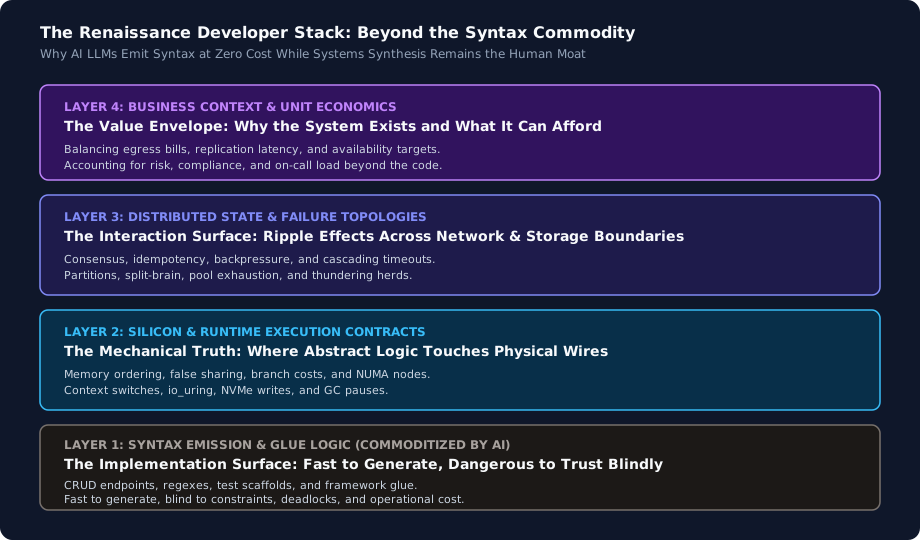
Figure 1: The Renaissance Developer Stack. Moving beyond syntax emission to master physical hardware, distributed failure topologies, and business unit economics.
Modern software engineering suffered through a decade of hyper-specialization. Engineers became “React developers” or “FastAPI developers,” insulated inside single-framework silos where database connection pools, memory allocators, and networking contracts were treated as black boxes.
Generative AI instantly dissolves framework silos because LLMs can generate boilerplate glue across any language or framework in milliseconds. If your entire skill set is knowing which syntax flags to pass to a framework routing function, your value has collapsed.
The Renaissance Developer operates across four interconnected layers that no AI model can reason about holistically:
1. Silicon and Hardware Physics
Software does not run in the cloud; it runs on hot silicon. A Renaissance Developer knows what their code does to the physical machine:
- How x86 Total Store Order (TSO) differs from ARM weak memory ordering when lock-free primitives are compiled (explored in detail in our analysis of the ISA as an architectural contract).
- How cache line false sharing degrades multi-threaded throughput on high-core server CPUs, or how memory bandwidth shapes accelerator efficiency in Apple M4 vs Huawei Ascend 950.
- Why NVMe flash write amplification turns unbuffered random writes into catastrophic disk I/O bottlenecks.
2. Distributed State and Failure Topologies
An AI model writes code as if the network is instantaneous, infinite, and reliable. A Renaissance Developer knows the network is a hostile, failing medium:
- How partial network partitions trigger split-brain states in distributed stores, and why asynchronous compensating workflows outperform brittle locks, as seen in sagas for microservice transactions.
- Why declarative infrastructure state collides with relational reality when migrations fight live traffic (dissected in our autopsy of GitOps and ArgoCD database realities).
- How backpressure signals prevent memory bloat when upstream producers outpace downstream consumers.
3. Business Context and Unit Economics
An LLM has never sat in an executive budget review. It does not know whether your startup has three months of runway or three years:
- It cannot tell you whether an API requires 99.999% availability or if 99.9% is sufficient to save $40,000 a month in cross-region replication costs.
- It cannot evaluate whether an in-memory Redis cache is worth the operational complexity compared to a well-indexed PostgreSQL query.
- It cannot balance customer SLOs against developer on-call fatigue.
4. Human Ergonomics and System Intent
Code is read ten times more often than it is written. A Renaissance Developer crafts architectures that humans can reason about, debug at 3 AM, and safely modify two years later.
The Anatomy of an AI Failure: The “Prompt-and-Pray” Concurrency Trap
To understand why systems thinking is the real engineering moat, inspect what happens when an AI generates concurrent backend code without systems constraints.
An engineer asks a frontier LLM: “Write a fast Go function that takes a slice of 10,000 user IDs, fetches their latest profile from PostgreSQL, and computes a score.”
The LLM returns this clean, idiomatic-looking code:
// Generated by AI: Looks clean, passes unit tests with a mock DB, kills production.
func ProcessUsers(ctx context.Context, db *sql.DB, userIDs []int64) ([]UserScore, error) {
    var (
        wg      sync.WaitGroup
        mu      sync.Mutex
        results []UserScore
    )

    for _, id := range userIDs {
        wg.Add(1)
        go func(userID int64) {
            defer wg.Done()

            var score UserScore
            query := `SELECT id, score, balance FROM users WHERE id = $1`
            err := db.QueryRowContext(ctx, query, userID).Scan(&score.ID, &score.Score, &score.Balance)
            if err != nil {
                log.Printf("failed to query user %d: %v", userID, err)
                return
            }

            mu.Lock()
            results = append(results, score)
            mu.Unlock()
        }(id)
    }

    wg.Wait()
    return results, nil
}
Why This Code Is a Production Disaster
When executed against a local SQLite database or a lightweight mock in a unit test with ten items, this code executes in milliseconds.
When deployed to production with 10,000 users, it triggers a catastrophic cascade:
- Unbounded Goroutine Spawning: The loop spawns 10,000 goroutines instantly. While a Go goroutine starts with only ~2 KB of stack space, 10,000 concurrent routines still demand 20 MB of initial memory and flood the Go runtime scheduler.
- Connection Pool Starvation:
sql.DBmanages a connection pool (by default, often capped atmax_connections = 100in Postgres). 10,000 goroutines contend simultaneously for 100 connections. 9,900 goroutines block, holding memory while waiting on the pool lock. - TCP Ephemeral Port and File Descriptor Churn: Under burst load, if the connection pool settings are unconfigured, the application attempts to open thousands of short-lived TCP sockets to PostgreSQL, exhausting operating system file descriptors and hitting socket backlog limits.
- PostgreSQL Worker Exhaustion: The database CPU spikes to 100% not from query execution, but from context switching between hundreds of active backend worker processes and lock contention on the buffer pool.
The AI wrote valid syntax. It remembered sync.WaitGroup and sync.Mutex. But it lacked systems awareness of resource boundaries.
The Renaissance Solution: Bounded Concurrency, Contexts, and Invariants
A Renaissance Developer looks at the problem through physical resource budgets:
- What is the database connection pool limit? (e.g., 25 connections allocated to this service).
- What is the maximum acceptable latency for the batch?
- What happens if the context cancels halfway through?
- How do we avoid memory allocation churn on the results slice?
Here is how an experienced engineer designs the same workflow:
// Hardened Systems Implementation: Bounded worker pool with backpressure
func ProcessUsersHardened(ctx context.Context, db *sql.DB, userIDs []int64, maxConcurrency int) ([]UserScore, error) {
    if len(userIDs) == 0 {
        return nil, nil
    }

    // Pre-allocate slice capacity to eliminate repeated slice reallocation copies
    results := make([]UserScore, len(userIDs))

    // Bound concurrent database operations using a buffered token channel (semaphore)
    sem := make(chan struct{}, maxConcurrency)

    // Track errors and cancellation cleanly
    g, ctx := errgroup.WithContext(ctx)

    for i, id := range userIDs {
        i, id := i, id // Pin loop variables

        // Acquire semaphore slot; blocks if maxConcurrency workers are active
        select {
        case sem <- struct{}{}:
        case <-ctx.Done():
            return nil, ctx.Err()
        }

        g.Go(func() error {
            defer func() { <-sem }() // Release semaphore slot back to pool

            // Enforce a strict per-query timeout to prevent connection hoarding
            queryCtx, cancel := context.WithTimeout(ctx, 1500*time.Millisecond)
            defer cancel()

            query := `SELECT id, score, balance FROM users WHERE id = $1`
            var score UserScore
            err := db.QueryRowContext(queryCtx, query, id).Scan(&score.ID, &score.Score, &score.Balance)
            if err != nil {
                return fmt.Errorf("user %d query failed: %w", id, err)
            }

            // Write directly to pre-allocated index: eliminates mutex lock contention entirely
            results[i] = score
            return nil
        })
    }

    if err := g.Wait(); err != nil {
        return nil, fmt.Errorf("batch processing aborted: %w", err)
    }

    return results, nil
}
Notice the systems decisions baked into this implementation:
- Bounded Semaphore:
maxConcurrencyensures that no matter how largeuserIDsgrows (10,000 or 1,000,000), the application will never checkout more connections than PostgreSQL’s connection pool can handle. - Lockless Writes via Index Pinning: By pre-allocating
results := make([]UserScore, len(userIDs))and writing directly toresults[i], we eliminatesync.Mutexlock contention across thousands of iterations. - Context Deadline Propagation:
queryCtxenforces a hard 1.5-second query deadline, guaranteeing that slow table scans do not hoard scarce database connections indefinitely. - Backpressure: The main loop blocks on
sem <- struct{}{}, preventing unbounded memory growth.
None of these decisions were about syntax. All of them were about systems invariants.
The New Division of Labor
The emergence of AI tools does not mean engineers should write every line of code by hand out of stubborn pride. That would be as foolish as an assembly programmer refusing to use a C compiler in 1975.
The optimal workflow is a sharp division of cognitive labor:
┌────────────────────────────────────────────────────────┐
│                    HUMAN ENGINEER                      │
│  Systems Architecture • Resource Invariants • Budgets   │
│  State Machine Transitions • Threat Models • Edge Cases│
└───────────────────────────┬────────────────────────────┘
                            │ Prompts & Constraints
                            ▼
┌────────────────────────────────────────────────────────┐
│                    AI CODE ENGINE                      │
│   Token Generation • Boilerplate Scaffolding           │
│   Regexes & Converters • Test Data Synthesizers        │
└───────────────────────────┬────────────────────────────┘
                            │ Raw Implementation
                            ▼
┌────────────────────────────────────────────────────────┐
│                    HUMAN ENGINEER                      │
│  Adversarial Audit • Failure Mode Verification         │
│  Physical Profile (CPU/Mem/IO) • Production Deployment │
└────────────────────────────────────────────────────────┘
Treat the AI as an ultra-fast, junior typographical assistant. Let it generate the boilerplate structs, write the initial regex pattern, or scaffold the unit test stubs.
Keep ownership of the boundaries:
- Never accept generated code you cannot mentally execute in your head. (See our architectural breakdown in The Four-Layer AI Coding Stack).
- Never deploy concurrent code without defining its physical saturation limits.
- Never let an AI assistant grade its own work. Maintain strict, independent test assertions, as detailed in Why I Don’t Let AI Grade Its Own Work.
Recommended Learning Paths & Systems Foundations
If you want to explore the deeper mechanics beneath the Renaissance Developer stack, check out these earlier deep dives:
- Silicon & Hardware Contracts: Read The ISA Is a Contract, Not a Benchmark to see how memory ordering and decoder silicon shape execution limits.
- Distributed State & Resilience: Read Sagas for Microservice Transactions and GitOps Reality with ArgoCD to master failure recovery without distributed locks.
- Pragmatic AI Workflows: Read The Four-Layer AI Coding Stack and Agentic Coding Assistants for production-proven guardrails.
What Comes Next
Understanding the systems moat is only the first step. To operate effectively as a Renaissance Developer, you must change how your brain absorbs and filters technical information.
When every API answer and code snippet is available in seconds, memorizing syntax creates an illusion of competence that quickly atrophies real engineering judgment. In Part 2 of this series, we explore the cognitive mechanics of software engineering:
- Read Part 2: Meta-Cognition for Software Engineers: How to Think in the Age of Instant Answers to understand how to separate perishable syntax from timeless primitives, and how to build internal mental runtime engines that never decay.